
What does it take to transform a small garage startup into a $3.8 trillion tech giant? The answer lies in innovation, adaptability, and a relentless drive to shape the future of computing. From its humble beginnings in 1975, this company has redefined how the world interacts with software and technology.
Over nearly five decades, the company has achieved milestones that changed industries. The dominance of Windows OS, the rise of Xbox in gaming, and the expansion of Azure cloud services highlight its journey. Today, it stands as a leader in AI and cloud computing, impacting businesses and consumers globally.
Under visionary leadership, the company shifted from a PC-focused vendor to a modern tech powerhouse. With a workforce of over 128,000 employees, it continues to push boundaries in enterprise solutions, gaming, and beyond.
Key Takeaways
- Started in 1975 and grew into a $3.8 trillion market cap company.
- Windows OS once held over 90% of the PC market in the 1990s.
- Xbox and Azure are key players in gaming and cloud computing.
- Now ranks as the second-largest cloud provider globally.
- Embraced AI and cloud innovation under current leadership.
Introduction: The Birth of a Tech Giant
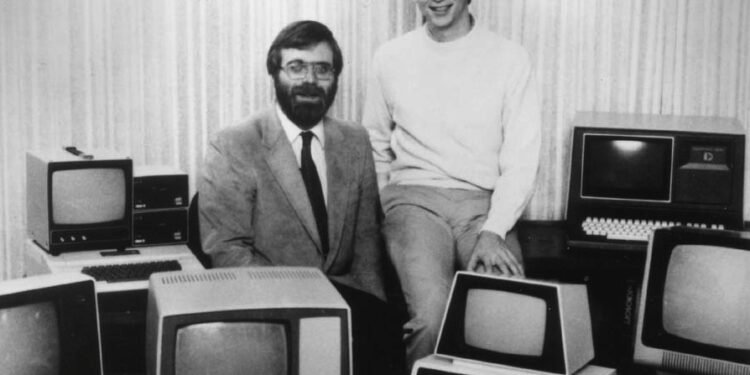
In 1975, two young visionaries set out to change computing forever. Bill Gates and Paul Allen developed a BASIC interpreter for the Altair 8800, marking their first step into the software industry. What began as a hobbyist project soon became the foundation of a global empire.
From Albuquerque to Global Dominance
Initially based in New Mexico, the duo relocated to Washington in 1979. The move aimed to tap into the growing tech talent pool. By 1980, they launched innovations like the Z-80 SoftCard and Xenix OS, proving their adaptability.
A pivotal moment came with the IBM partnership in 1980. The deal involved providing a disk operating system (MS-DOS) for IBM’s PCs. Royalties from every sale fueled rapid expansion. By 1986, their Nasdaq IPO raised $61 million, funding offices worldwide.
Early products like Multi-Tool Word (1983) hinted at their future in productivity software. Each milestone reinforced their influence on the personal computer revolution. The stage was set for decades of innovation.
The Microsoft Story: A Legacy of Innovation
Two childhood friends sparked a computing revolution with their bold vision. Bill Gates and Paul Allen combined business savvy and technical genius to create tools that shaped the digital age. Their early work set the stage for decades of industry leadership.
Bill Gates and Paul Allen’s Vision
The duo met in high school, bonding over a shared passion for programming. Gates’ sharp business instincts paired perfectly with Allen’s engineering skills. By 1975, they turned their hobby into a company with a clear goal: to put “a computer on every desk.”
Their first office was a tiny space in Albuquerque. Within three years, the team grew to 13 employees, including Ric Weiland, a high school collaborator. The founders prioritized hiring talent who shared their innovative spirit.
Altair BASIC and the First Breakthrough
Inspired by a 1974 Popular Electronics cover, Gates and Allen developed Altair BASIC in just eight weeks. They coded without access to the actual hardware—a feat of creativity. This interpreter became the first programming language for microcomputers.
- Early success: Generated $16,000 in first-year revenue.
- Licensing model: Unlike competitors, they sold software rights instead of one-time copies.
- Workforce growth: Expanded rapidly to meet demand for their tools.
Altair BASIC proved that software could drive hardware adoption. This philosophy later defined their approach to the microsoft operating system market.
1975-1985: Founding and Early Innovations
A groundbreaking IBM deal in 1981 catapulted a fledgling software company into the tech stratosphere. The founders’ knack for strategic partnerships and adaptable business models turned early projects into industry standards. Within a decade, they reshaped computing for millions.
MS-DOS and the IBM Partnership
In 1981, the company acquired 86-DOS for under $100,000, rebranding it as PC DOS for IBM’s first personal computer. The deal included a revolutionary royalty system—earning a fee for every IBM PC sold. By 1984, over 1 million machines ran the operating system, cementing its dominance.
Key to this success was the licensing strategy. Unlike competitors, bill gates paul allen prioritized recurring revenue over one-time sales. This approach funded rapid expansion, including hiring Steve Ballmer in 1983.
The Rise of Microsoft BASIC
Before MS-DOS, the company’s BASIC interpreter dominated early microcomputers. Versions for Apple II and Commodore 64 became essential tools for developers. The language’s simplicity and widespread adoption laid the groundwork for future windows operating system success.
Hardware ventures like the Z-80 SoftCard (1980) showcased versatility, enabling CP/M software on Apple II. Yet Paul Allen’s departure in 1983, due to illness, marked the end of an era. The stage was set for a new chapter in tech history.
1985-1994: Windows and Office Take Center Stage
The mid-1980s marked a turning point as software innovation shifted from command lines to visual interfaces. This period saw the birth of products that would define personal computing for decades. Companies raced to make technology accessible to everyday users through intuitive designs.
Launching Windows 1.0
November 1985 introduced Windows 1.0, challenging the dominance of text-based systems. Its tiled graphical user interface allowed navigation through drop-down menus and dialog boxes. Though limited by today’s standards, it pioneered concepts like scroll bars and on-screen calculators.
Early adopters were skeptical about the need for visual elements. The system required 2 floppy disks and 256KB RAM—substantial resources for the era. However, Windows 3.1’s 1992 release silenced critics with improved performance and the iconic Solitaire game.
Microsoft Office Suite Debuts
1989 revolutionized productivity software with the bundled release of microsoft office. Word, Excel, and PowerPoint offered seamless integration—a stark contrast to standalone competitors. Businesses especially valued the consistent interface across applications.
The strategy crushed rivals like WordPerfect and Lotus 1-2-3. By 1993, over 90% of PCs ran these tools, establishing document standards still used today. This dominance funded research into multimedia innovations like Encarta.
The OS/2 Rivalry
A $250 million partnership with IBM to develop OS/2 collapsed in 1991. The company prioritized windows development despite joint investment. This decision strained relations but allowed full control over the GUI market.
By 1993, Windows held 90% market share, while OS/2 languished. The victory demonstrated the importance of owning platform ecosystems. Simultaneously, Encarta’s 1993 launch showcased the potential of CD-ROM educational tools.
1995-2007: Conquering the Web and Gaming
The mid-90s ushered in a digital revolution that redefined how people interacted with technology. The rise of the world wide web and demand for multimedia experiences pushed the company beyond traditional software. Over 12 years, it dominated browsers, reshaped gaming, and faced regulatory battles.
Windows 95 Revolutionizes Computing
August 1995 saw the launch of Windows 95, introducing the iconic Start menu and taskbar. Over 7 million copies sold in five weeks, making it the fastest-selling OS at the time. Its plug-and-play hardware support simplified PC setups for home users.
The OS integrated MS-DOS and Windows seamlessly, boosting performance. Features like file shortcuts and the Recycle Bin became staples. Developers embraced its 32-bit architecture, fueling a wave of compatible video games and applications.
Internet Explorer vs. Netscape
The browser wars erupted when Internet Explorer debuted alongside Windows 95. Bundling it for free crippled Netscape’s market share, sparking a 1999 antitrust lawsuit. By 2002, IE held 95% dominance, though critics argued it stifled innovation.
MSN emerged as an early internet services contender, rivaling AOL. However, mobile efforts like Windows CE struggled against Palm OS, revealing gaps in handheld strategies.
Xbox Enters the Gaming Arena
A $4 billion bet in 2001 brought Xbox to life, challenging Sony and Nintendo. The console’s built-in Ethernet port emphasized online multiplayer—a first for its generation. Halo: Combat Evolved became a system-seller, proving the brand’s gaming credibility.
Despite early losses, Xbox Live (2002) pioneered subscription-based online play. This move laid groundwork for future cloud gaming initiatives.
The Antitrust Battles
Regulatory scrutiny became a defining challenge as the company’s market dominance grew. Between 1999-2008, legal actions in the united states and Europe forced fundamental changes in software distribution practices. These cases set precedents that still influence tech competition today.
Landmark 1999 Monopoly Trial
The U.S. Department of Justice proved the company abused its Windows monopoly by bundling Internet Explorer. Courts ruled this harmed consumer choice and stifled browser innovation. Proposed remedies included splitting the firm into separate OS and applications businesses.
Though the breakup order was overturned in 2001, the case transformed software licensing. Developers gained access to critical API documentation, enabling rival programs to integrate with the operating system.
European Union Regulatory Actions
EU regulators imposed €1.4 billion in fines between 2004-2008 for anti-competitive practices. The 2004 ruling required a special Windows N edition without Media Player as a bundled service. Later penalties targeted Office interoperability and browser selection screens.
These interventions created opportunities for emerging rivals. Google and Apple capitalized on the changed landscape, particularly in web services and mobile platforms. The cases remain benchmarks for tech regulation worldwide.
2000-2014: The Ballmer Era
Under Steve Ballmer’s leadership, the company faced rapid industry shifts and evolving consumer demands. This period saw landmark achievements in desktop software but revealed critical gaps in adapting to mobile trends. The strategy of prioritizing familiar markets over emerging ones yielded mixed results.
Windows XP and Vista
Launched in 2001, Windows XP became the most successful OS yet, with 400 million copies sold. Its stability and user-friendly experience attracted 450 million users at its peak. The system’s 25 million lines of code supported everything from home PCs to enterprise networks.
Vista’s 2007 debut faltered due to high hardware requirements and driver issues. Despite a $200 million marketing push, the $6 billion development project struggled. Users rejected its intrusive security prompts, pushing many back to XP.
Missed Opportunities in Mobile
The era’s biggest missteps came in mobile. The Zune media player, discontinued in 2011, failed to challenge Apple’s iPod. Windows Phone 7’s 2010 launch garnered under 3% market share by 2013, hampered by app shortages.
A $7.2 billion Nokia acquisition in 2013 aimed to salvage mobile ambitions but was later written down. Meanwhile, the 2012 Surface tablet launch marked a pivot—competing with iPads while showcasing hybrid devices for productivity.
2014-Present: Nadella’s Cloud-First Vision
A new era dawned in 2014 as leadership shifted focus toward cloud computing dominance. The “mobile-first, cloud-first” mantra replaced Windows-centric strategies, prioritizing scalable services for modern enterprises. This pivot fueled unprecedented growth across business segments.
Azure and the Cloud Computing Surge
Azure revenue skyrocketed from $19 billion in 2018 to $56 billion by 2022. The platform surpassed AWS in government contracts and expanded to 60+ global datacenter regions. Investments in hybrid cloud solutions attracted enterprises needing flexible infrastructure.
Acquisition of LinkedIn and GitHub
A $26.2 billion LinkedIn purchase in 2016 created the largest professional network for B2B marketing. GitHub joined for $7.5 billion in 2018, securing a vital developer ecosystem. These deals complemented Teams’ rise to 300 million monthly users.
Strategic moves included a $10 billion OpenAI investment, integrating AI through Copilot. The cloud-first approach transformed the company into a leader for businesses embracing digital transformation.
Key Products That Shaped the Industry
The digital landscape transformed as software solutions became essential for businesses and individuals alike. Flagship products redefined how people interact with technology, from desktops to cloud platforms. These innovations cemented the company’s role as a tech pioneer.
Windows Operating System Evolution
Windows 10 debuted in 2015 as the “last version” of the OS, shifting to continuous updates. This approach streamlined security patches and feature rollouts. Over 1.3 billion devices ran it by 2020, proving its adaptability.
Windows 11 launched in 2021 with a redesigned Start menu and Android app support. Its focus on touch and processing efficiency catered to hybrid work. The OS powers everything from budget laptops to high-end machines, maintaining 75% market share.
Microsoft 365 and Productivity Tools
Office 365 rebranded to Microsoft 365 in 2020, emphasizing cloud integration. The SaaS model grew to 345 million paid seats, offering Teams, OneDrive, and AI-powered Editor. Subscriptions outpaced traditional license sales by 2022.
Enterprise tools like Dynamics CRM rival Salesforce with deep Office integration. Meanwhile, Power Platform empowers 16 million monthly users to build low-code apps. Surface devices complement this ecosystem, generating $7 billion annually.
These products demonstrate how software can evolve to meet modern demands. From the windows operating system to collaborative suites, they remain industry benchmarks.
Microsoft’s Business Segments Today
Three core divisions drive today’s digital transformation across industries worldwide. With $216 billion in FY2023 revenue, these segments showcase how the company evolved beyond software licensing. Each unit addresses distinct market needs while sharing AI and cloud infrastructure.
Productivity and Business Processes
The $69 billion productivity segment powers modern workplaces through integrated solutions. Microsoft 365 combines Word, Excel, and Teams with LinkedIn Learning’s 17,000 professional courses. This business unit thrives on subscription models, serving 345 million paid seats globally.
Intelligent Cloud: Azure’s Dominance
Azure’s $88 billion revenue reflects leadership in hybrid cloud solutions. Specialized offerings like Azure Stack help regulated industries maintain compliance. The platform’s OpenAI integration brings GPT-4 capabilities to enterprise applications.
More Personal Computing: Surface and Xbox
From adaptive accessories to Game Pass subscriptions, this $59 billion segment reimagines user interaction. Surface Neo’s dual-screen concept pushes devices forward, while Xbox Cloud Gaming delivers 400+ titles to 25 million subscribers. These innovations demonstrate how hardware and service models coexist.
Global Expansion and Research
Cutting-edge labs across six continents fuel breakthroughs in next-gen technologies. The 8-million-square-foot Redmond headquarters anchors a network of research centers from Cambridge to Bengaluru. This infrastructure supports 23,000+ researchers tackling challenges from climate change to advanced computing.
Worldwide Campus Locations
Specialized facilities in Beijing and Montreal focus on AI and mixed reality development. The Bengaluru lab pioneers cost-effective solutions for emerging markets. Each location adapts technology to regional needs while contributing to global projects.
AI and Quantum Computing Initiatives
Azure Quantum now supports 100+ qubit systems for solving complex logistics and chemistry problems. The Responsible AI Standard v2 framework ensures ethical deployment across hardware and software. These efforts position the company at the forefront of secure, scalable innovation.
Sustainability drives operational decisions, with datacenters transitioning to 100% renewable energy by 2025. Military and industrial applications of HoloLens demonstrate how research translates into real-world solutions. From quantum algorithms to carbon-neutral clouds, these initiatives redefine what’s possible.
Cultural Impact and Philanthropy
Beyond technology, the company’s influence extends to global health and sustainability. Its initiatives address critical challenges, from pandemics to climate change, while empowering underserved communities.
Gates Foundation and Global Health
With a $50B+ endowment, the Gates Foundation has revolutionized healthcare in developing nations. During COVID-19, AI tools analyzed outbreaks, while Teams connected remote medical teams. The Seeing AI app enhanced consumer accessibility for the visually impaired.
Philanthropic engineering includes $1B in cloud donations to nonprofits. A digital skilling program aims to train 25M workers worldwide, bridging gaps in the modern businesses landscape.
Environmental Commitments
The $1B Climate Innovation Fund supports carbon-capture technologies. By 2030, the company plans to be carbon-negative, erasing its historical emissions by 2050. Renewable energy powers its datacenters, reducing the world’s digital footprint.
From AI-driven sustainability to inclusive experiences, these efforts redefine corporate responsibility. The focus remains on scalable solutions that benefit both people and the planet.
Competitors and Market Position
Tech giants constantly battle for dominance across software, hardware, and cloud services. The Wall Street Journal reports shifting market caps, with Apple briefly surpassing its rival in 2024. This fierce competition drives innovation in enterprise tools and consumer products alike.
Rivalry with Apple and Google
Productivity suites face off as Office 365 competes with Google Workspace in the service sector. Teams gained 300 million users, challenging Zoom and Slack for video conferencing leadership. Meanwhile, Dynamics CRM battles Salesforce in enterprise solutions.
Browser wars continue with Edge integrating AI features against Chrome’s market dominance. The gaming division competes through Xbox Game Pass, offering 400+ titles versus PlayStation’s exclusives. Cross-platform availability of Office apps on iOS and Android demonstrates strategic adaptability.
Cloud Wars: AWS vs. Azure
Azure holds 23% market share against AWS’s 29% in the cloud infrastructure race. The platform differentiates through hybrid solutions and OpenAI integration. Analysts predict narrowing gaps as enterprises adopt multi-cloud strategies.
AI development accelerated with Copilot challenging Google Bard and Apple Siri. Legal battles emerge too, like Epic Games’ lawsuit over Xbox Store fees. These conflicts highlight evolving digital marketplace regulations.
Looking ahead, quantum computing and metaverse investments may redefine competitive advantages. The company’s diversified approach across devices, software, and services maintains its position as an industry titan.
Failures and Lessons Learned
Innovation often comes with setbacks, and even industry giants face costly missteps. Some products failed to resonate, while others arrived at the wrong *time*. These experiments, though short-lived, offered valuable insights into market demands.
Microsoft Bob and Other Missteps
In 1995, a cartoonish interface called Bob aimed to simplify PCs for beginners. It lasted just a year, criticized for being patronizing and slow. The $100M project highlighted the risks of misaligned *consumer* needs.
Windows 8’s radical redesign in 2012 alienated enterprise users. Its touch-first approach ignored desktop workflows, forcing a reversal in Windows 10. Similarly, Cortana couldn’t compete with Alexa or Siri, lacking third-party integrations.
Zune and Windows Phone’s Decline
The Zune media player, launched in 2006, couldn’t dethrone the iPod. A $289M write-off followed. Windows Phone struggled with app shortages, despite Nokia’s $7.6B acquisition. Both faltered against Apple and Android’s ecosystems.
- Social media: So.cl network shut down after two years.
- Hardware: Kin phones and Band fitness tracker flopped.
- Lesson: Late entries need superior *experience*, not just features.
The Future of Microsoft
Artificial intelligence and immersive experiences dominate the roadmap for modern computing platforms. With $10 billion invested in OpenAI, the company is embedding AI across its ecosystem. This strategic shift focuses on creating intelligent tools that enhance productivity and redefine human-machine interaction.
AI Integration Across Products
GitHub Copilot already assists 1.8 million developers with AI-generated code suggestions. Office 365 now features writing assistants that draft emails and summarize documents. Windows 11 integrates these capabilities directly into the operating system through centralized Copilot controls.
The quantum computing initiative aims to build a supercomputer within ten years. Azure’s AI infrastructure supports this effort with specialized hardware accelerators. Cybersecurity receives parallel attention through a $20 billion investment to protect hybrid work environments.
Expanding the Metaverse with HoloLens
A 120,000-unit US Army contract proves HoloLens’ potential beyond consumer devices. Azure Digital Twins creates virtual replicas of factories and cities for simulation. Mesh for Teams brings holographic meetings to everyday collaboration.
The $69 billion Activision Blizzard acquisition bridges gaming and the metaverse. This move provides content for Xbox Cloud Gaming’s 25 million subscribers. Combined with AI advancements, these technology stacks position the company at the forefront of immersive experiences.
From quantum algorithms to mixed reality, the platform strategy focuses on interconnected innovation. Each advancement builds toward an ecosystem where AI enhances every digital interaction. The future lies in seamlessly blending physical and virtual worlds.
Conclusion: A Legacy of Transformation
Few companies have shaped modern technology as profoundly as this tech pioneer. Over five decades, it evolved from a BASIC interpreter to an AI and cloud leader, impacting billions worldwide. Today, its $3.8 trillion market cap reflects sustained innovation and adaptability.
The workforce now thrives with 60% technical roles, driving breakthroughs in quantum computing and sustainability. Since 2020, it operates as a carbon-negative company, setting industry standards. Enduring influence spans 1.4 billion devices and millions of developer repositories—proof of a legacy built to last.
FAQ
Who founded the company, and what was their first major product?
Bill Gates and Paul Allen founded the company in 1975. Their first major success was Altair BASIC, a programming language for early personal computers.
How did MS-DOS help establish the company’s dominance?
MS-DOS became the standard operating system for IBM PCs in the 1980s, giving the company a crucial foothold in the personal computing market.
What made Windows 95 a game-changer?
Windows 95 introduced a user-friendly graphical interface, multitasking, and built-in internet support, making PCs more accessible to everyday users.
Why did the company face antitrust lawsuits?
Regulators accused the company of anti-competitive practices, such as bundling Internet Explorer with Windows to dominate the browser market.
What were some key failures in the company’s history?
Products like Microsoft Bob, Zune, and Windows Phone struggled due to poor market timing or strong competition from rivals like Apple and Google.
How did cloud computing transform the company under Satya Nadella?
Nadella shifted focus to cloud services like Azure, driving growth and making the company a leader in enterprise and AI-driven solutions.
What role does Xbox play in the company’s strategy?
Xbox expanded the company into gaming, competing with Sony and Nintendo while integrating services like Game Pass into its ecosystem.
How does the company contribute to global philanthropy?
Through the Gates Foundation, it supports education, global health, and sustainability initiatives worldwide.
What are the company’s current business segments?
Its three main segments are Productivity and Business Processes (Office, LinkedIn), Intelligent Cloud (Azure), and More Personal Computing (Windows, Surface, Xbox).
What’s next for the company in AI and the metaverse?
It’s investing heavily in AI integration across products like Copilot and exploring mixed-reality applications with HoloLens and Mesh.