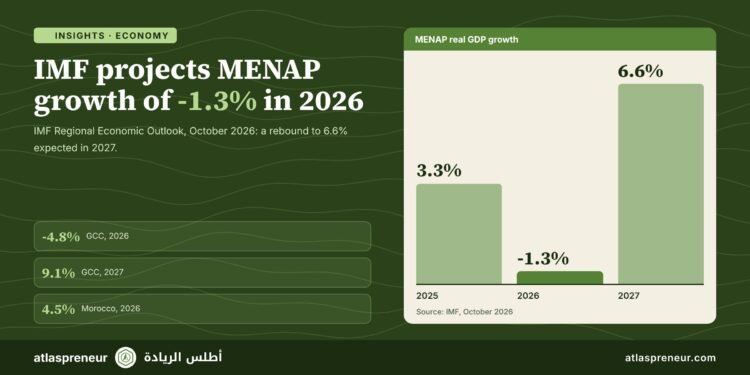
The International Monetary Fund projects the Middle East, North Africa, Afghanistan and Pakistan (MENAP) region to contract by 1.3% in 2026, after growth of 3.3% in 2025, and to rebound by 6.6% in 2027, according to its Regional Economic Outlook for the Middle East and Central Asia, titled Steering through Uncertainty and released in Dubai on 22 October 2026. Oil-importing economies such as Morocco hold up better than the regional average.
For entrepreneurs and investors in the Arab region, the outlook sets the growth, price and policy conditions for the next two years.
About the report
| Publisher | International Monetary Fund (IMF), Middle East and Central Asia Department |
| Released | 22 October 2026, Dubai |
| Title | Regional Economic Outlook: Middle East and Central Asia, October 2026. Steering through Uncertainty: Strengthening Resilience in Challenging Times |
| Data covered | Growth projections for 2025 to 2027 for MENAP, the GCC and the Caucasus and Central Asia, with policy recommendations |
| Latest edition? | Yes, as of November 2026. The report is published twice a year. |
Key findings
- MENAP growth is projected at minus 1.3% in 2026, down from 3.3% in 2025, before a rebound to 6.6% in 2027, according to the IMF.
- The Gulf Cooperation Council economies are projected to contract by 4.8% in 2026 and to grow by 9.1% in 2027, the IMF says.
- Oil importers are more resilient, supported by remittances and tourism. Morocco is projected to grow 4.5% in 2026 and 4.2% in 2027.
- The Caucasus and Central Asia keep growing, at 6.2% in 2025, 5.2% in 2026 and 5% in 2027, according to the IMF briefing.
- The IMF has provided about $48 billion in financing to countries in the region since 2020 and ran 437 technical assistance projects in 31 countries in its 2026 financial year.
- Its policy priorities are price stability, rebuilding fiscal buffers, targeted transfers for vulnerable households, trade diversification and faster adoption of artificial intelligence.
IMF growth projections by group, in percent:
| Region or country | 2025 | 2026 | 2027 |
|---|---|---|---|
| MENAP | 3.3 | -1.3 | 6.6 |
| GCC | n/a | -4.8 | 9.1 |
| Caucasus and Central Asia | 6.2 | 5.2 | 5.0 |
| Morocco | n/a | 4.5 | 4.2 |
What the outlook means for entrepreneurs in the region
- Plan for a weak 2026 in the Gulf. A projected 4.8% contraction in the GCC means slower demand and tighter budgets. Startups selling to Gulf governments or large corporates should expect longer sales cycles this year.
- Position for the 2027 rebound. The IMF expects strong growth in 2027. Companies that keep their teams and pipeline through 2026 will be ready when demand returns.
- Oil importers offer steadier markets. With Morocco projected above 4% in both years, North African markets supported by remittances and tourism may offer more stable demand in the short term.
- Follow the policy agenda. Trade diversification and AI adoption are IMF priorities. Ventures that support exports or help firms adopt AI fit the direction governments are being advised to take.
📥 Download the full report
The IMF publishes the full Regional Economic Outlook, with country tables, on its publications page. The report is published by the IMF, not by Atlaspreneur.
FAQ
A contraction of 1.3% in 2026, after growth of 3.3% in 2025, followed by growth of 6.6% in 2027.
A contraction of 4.8% in 2026 and growth of 9.1% in 2027.
The IMF projects 4.5% in 2026 and 4.2% in 2027.
Middle East, North Africa, Afghanistan and Pakistan, one of the regional groups the IMF uses in its outlook.
Price stability, rebuilding fiscal buffers, targeted transfers for vulnerable households, trade diversification and faster AI adoption.
Sources
- IMF: Middle East and Central Asia Department press briefing transcript, October 2026
- IMF: Publications