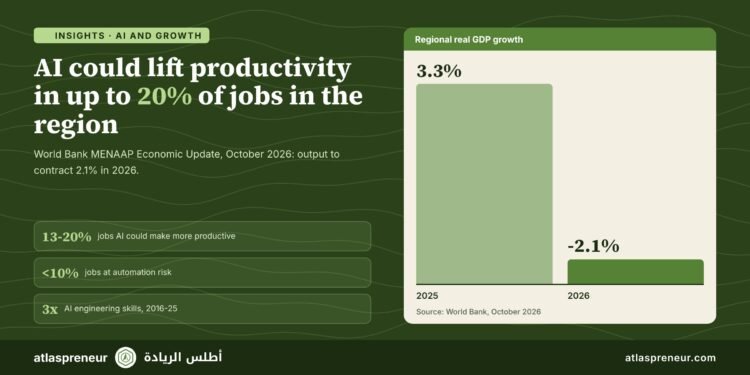
Artificial intelligence could raise productivity in 13% to 20% of jobs in the Middle East, North Africa, Afghanistan and Pakistan, while fewer than 10% face near-term automation risk, according to the World Bank’s MENAAP Economic Update, October 2026: From Divide to Opportunity: AI, Jobs, and Growth, published on 6 October 2026. The same report projects regional output to contract by 2.1% in 2026.
For entrepreneurs in the region, the report combines a difficult short-term outlook with a clear map of where AI creates business opportunities.
About the report
| Publisher | World Bank, Office of the Chief Economist for the Middle East, North Africa, Afghanistan and Pakistan |
| Released | 6 October 2026 |
| Title | MENAAP Economic Update, October 2026: From Divide to Opportunity: AI, Jobs, and Growth |
| Data covered | Regional growth outlook for 2025 and 2026, plus analysis of AI’s effect on jobs and productivity |
| Latest edition? | Yes, as of November 2026. Published twice a year. |
Key findings
- Regional output is projected to contract by 2.1% in 2026 after growth of 3.3% in 2025, driven by the conflict and the closure of the Strait of Hormuz, according to the World Bank.
- AI could increase productivity in 13% to 20% of jobs, especially in services, the report finds.
- Fewer than 10% of jobs face near-term automation risk. In the near term, AI is more likely to complement workers than replace them.
- Three gaps hold the region back: a localization gap (regional languages are underrepresented in AI training data), a usage gap, and a foundational gap in physical and human capital.
- The share of LinkedIn members with AI engineering skills more than tripled between 2016 and 2025 in Bahrain, Jordan, Morocco, Pakistan and Tunisia. GCC countries are net importers of AI talent, while several middle-income economies are net exporters, according to the report.
The report’s main figures, according to the World Bank:
| Indicator | Value |
|---|---|
| Regional growth, 2025 | 3.3% |
| Projected regional growth, 2026 | -2.1% |
| Jobs where AI could raise productivity | 13% to 20% |
| Jobs at near-term automation risk | Fewer than 10% |
The World Bank’s 2026 projection is more negative than the IMF’s minus 1.3% for the same region, covered in our summary of the IMF Regional Economic Outlook, October 2026. Both institutions expect 2026 to be a contraction year.
What the report means for entrepreneurs in the region
- Sell productivity, not replacement. With AI able to lift productivity in up to one job in five and threatening fewer than one in ten, tools that make teams faster are easier to sell than tools that cut headcount.
- Arabic and local language AI is a market. The localization gap is a business opportunity for startups building data, models and products in the region’s languages.
- Adoption services are needed. The usage gap means companies have access to AI but do not use it well. Training, integration and implementation services fit this need.
- Talent flows to the Gulf. Founders in North Africa and Jordan compete with GCC employers for AI engineers. Remote work models and equity can help retain them.
📥 Download the full report
The World Bank publishes the full report free of charge on its website. The report is published by the World Bank, not by Atlaspreneur.
FAQ
A contraction of 2.1% in 2026, after growth of 3.3% in 2025.
Between 13% and 20% of jobs in the region, especially in services, according to the World Bank.
Fewer than 10% face near-term automation risk.
Middle East, North Africa, Afghanistan and Pakistan, the region covered by this World Bank update.